Op-Ed
The Watchman Has Walked Off the Wall
What hurricanes cost a small island, and why climate denial in Washington is a sentence passed on us
By Prof C. Justin Robinson, Pro Vice Chancellor and Campus Principal, UWI Five Islands Campus
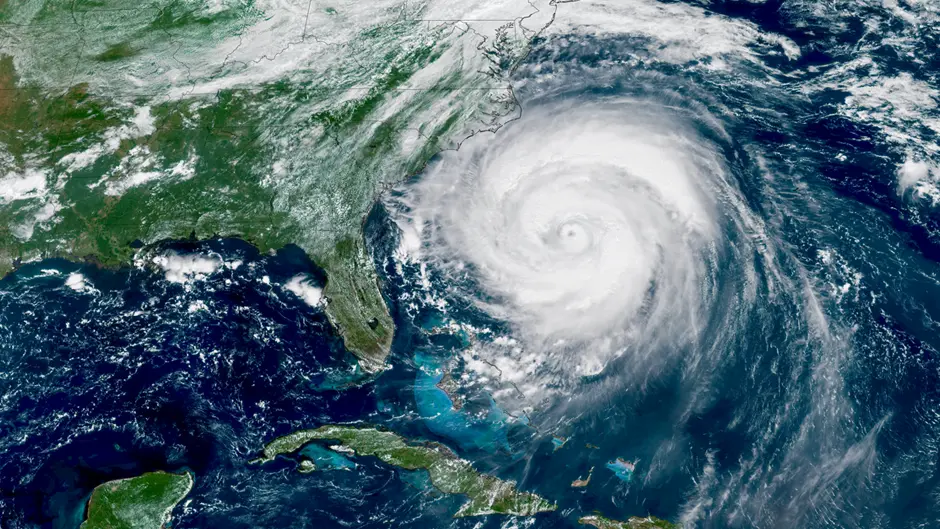
It is June, and the 2026 hurricane season has arrived, as it has for centuries. As a boy in St. Vincent & The Grenadines, I learned the season through a nursery rhyme: June too soon, July standby, August a must, September remember, October not yet over. But the season did not arrive on a calendar. It arrived on the radio, in the particular flatness a broadcaster’s voice takes when reading coordinates and wind speeds. I remember the grown people going quiet , the change in their faces, the flashlight and candles found, the hunt for extra batteries. Now the season arrives on Facebook, and we watch a cone online. But the truth has not changed, a storm is something others see before we do. And being seen in time is the difference between a hard week and a funeral. Washington has now made it harder to see the storms in time.
I remember the year we lost the Chateaubelair fishing fleet. A friend, let us call him Joseph, had just paid off his thirty-foot boat: seven years of skipped lunches and mended nets. Then Hurricane Lenny came in November 1999 — wrong season, wrong direction, out of the west into a coast we thought safe. He tied three ropes to the boat. By morning, the ropes were there, frayed clean. The boat was gone! He did not cry,he just sat on the beach where the sand had been rearranged into something foreign. A month later, he left for work on a cruise ship out of Miami. He has come home four times in twenty-five years. That is what a hurricane does, it does not always kill you. It relocates the life you were meant to live onto someone else’s terms.
In July 2024, neither the radio nor the internet could save the Grenadines. Hurricane Beryl, the earliest Atlantic Category 5 on record, took ninety percent of Union Island’s houses and every roof on Mayreau. I met a woman there three weeks later. Let us call her Celia. She had sheltered in the stone church with her two children. During the eye, her four-year-old, let us call him Malachi, asked, Mummy, is God angry at us? She told him no. She did not tell him the walls were shaking, the stained glass turning to a horizontal rain of coloured needles. When they emerged, one wall of her house still stood. Pinned to it, where the kitchen had been, a baby photograph of Malachi. That photograph will cross oceans before she ever sees a cheque from a Loss and Damage fund.
The Caribbean has warmed by nearly 2°F since 1980. That is not a statistic. That is Beryl reaching Category 5 in July instead of September.
A hurricane is not a weather event for a Caribbean nation. It is a development event and it runs development in reverse. When Maria sat over Dominica in 2017, it cost 226 percent of that country’s annual output, more than two years of everything a nation produces, gone in a single night. Ninety percent of the housing stock. The whole grid, dark. Poverty projected to leap toward forty-three percent. The money does not fall from the sky, so Dominica borrowed against its children’s future to replace what it had already paid for once.
Here is a number that appears in no World Bank brief. Maria struck two years after Tropical Storm Erika had already gutted the island. Afterward, a teacher in Roseau described pupils who had lost three homes since 2015. They were twelve years old, three homes, one childhood. We are struck again before we finish rebuilding, mortgaging the same schools and clinics twice in a single generation, and billed for the privilege. Post-traumatic growth means nothing when the trauma recurs every eighteen months. These children are not resilient, they are exhausted. We call it resilience because the alternative, that we have abandoned them, is unbearable.
So forgive me if this year’s forecast brings no relief. NOAA expects a below-normal season. We are meant to breathe out, we should not. Every forecaster attached the same warning, it only takes one. A “quiet” season is not few storms. It is fewer chances for the one that finds you.
Who is watching the sky with us? The answer has been deliberately changed. In February, the United States revoked the legal finding that greenhouse gases endanger human health, even as its own National Academies called the evidence stronger than ever. The administration did not refute the science, it stepped around it. And a cabinet secretary announced that “CO₂ was never a pollutant.” Picture a man in a warm office declaring carbon harmless while Mayreau climbs from its collapsed church into the wreckage of all it owned. He will never bury anyone. He lives in a world where the climate bills fall elsewhere , on islands that emitted almost nothing and will pay almost everything.
And this denial has hands. Washington has cut hundreds of weather-service jobs and proposed gutting the Miami laboratories where forecasting is sharpened, without which, experts say, accuracy could fall by as much as forty percent. Translate that for a mother in Basseterre, Bridgetown, Castries, Kingstown, Kingston, St Georges or St John’s. It is the difference between evacuating your grandmother and leaving her because the storm was supposed to turn north. That is not a model, that is the margin between life and a search party. The storms feed on water made hotter by the very emissions now declared harmless. The cone that tells a family whether to board up tonight or tomorrow comes from Miami. When Washington blinds itself, it blinds us.
Lloyd Best taught us to read this economy as a plantation, built for the metropole, our survival a leftover. The instruments meant to protect us were always held in another’s hand, the Paris Agreement the U.S. has now left, the Loss and Damage Fund whose board it abandoned, the climate pledge that evaporated. When the metropole decides science is negotiable, we do not get a vote. We get a bill and a grave to dig. The colonial mind did not die. It was repackaged as a budget and sold at home as a country put first.
But the failure is not only Washington’s. In May, when Vanuatu, a Pacific island no larger than ours, carried the world court’s climate ruling to the General Assembly, asking only that states affirm their legal duty to the vulnerable, one of our own, Trinidad and Tobago, was absent from the vote. Not opposed, not abstaining. Simply not there, while a sister island spoke for us all. We cannot demand solidarity we do not practice.
This is not a season to endure and forget. The man who leads the administration that decided carbon does no harm holds the office for this hurricane season and two more, 2026, 2027, 2028, and the Constitution that denies him a third term does not bind the damage to that schedule. Capacity is unmade in a season and rebuilt over a decade. Whoever follows him inherits a watchtower with its eyes already put out. When we say the Caribbean cannot wait, we are reading a calendar, three seasons of facing the sky with a warning system starved on purpose. Our lives are at risk and to wait is to wager them.
We will not wager them. The lament must become a vow, because despair is only dependency in darker clothes. We are not starting from nothing, a regional disaster agency that answered Beryl, an insurance facility that pays within days, a meteorological institute in Barbados that trains our forecasters. What it lacks is scale, financing, and seriousness.
So let us find partners and build. Our own satellite reception, free of any foreign budget cycle. Our own forecasting centre, free to issue warnings without Miami’s signature. Our own disaster-bond facility, funded by a levy on the tourists who enjoy our beaches while we carry the risk. Let us set deadlines, B the 2029 hurricane season, a Caribbean-owned forecasting capability. By 2030, a regionally capitalized disaster bond. The work does not require Washington’s permission, only our own resolve.
Build it, finally, for the people who actually live here. For Celia and Malachi. For the children in Roseau who have lost three homes before puberty.
I think of those faces around the radio, straining to hear a voice that could see the storm before they could. That voice is being switched off now, by choice, in another hemisphere. The watchman has walked off the wall and called it freedom. The wall is still ours. Our children are behind it.
We had better learn to hold it. No one is coming.







Sir Ronald Sanders invited to deliver St. Paul’s 190th Anniversary Lecture on Racism and Reparations in New York

Antigua and Barbuda Strengthens United Kingdom Engagement Ahead of CHOGM2026

Minister Greene and Commonwealth Secretary-General Review Final CHOGM 2026Preparations and Ministerial Priorities

The Endurance Economy: Part 3: Paying Twice

A&B OFFICIALS TO HOLD FRESH TALKS WITH JET BLUE NEXT WEEK

MESSAGE BY THE HONOURABLE GASTON BROWNE PRIME MINISTER OF ANTIGUA AND BARBUDA ON THE OCCASION OF AFRICA-CARICOM DAY 2026

MAN IN CRITICAL CONDITION FOLLOWING STABBING IN VILLA

SIBLINGS THANKFUL FOR TWO-BEDROOM HAPI HOME

ARMED ROBBERS TARGET SERVICE STATION AT BUCKLEY LINE

CLIPPERS FINED FOR SALARY RULES VIOLATION
ABS EVENING NEWS (LOCAL SEGMENT & WEATHER REPORT) 19.1.2024
ABS EVENING NEWS (LOCAL SEGMENT & WEATHER REPORT) 18.1.2024
ABS EVENING NEWS (LOCAL SEGMENT & WEATHER REPORT) 16.1.2024
ABS EVENING NEWS (LOCAL SEGMENT & WEATHER REPORT) 14.1.2024